


I wonder where to start. As I tell you my story, will you find it hard to empathize? I am what some call an unreliable character and I have done something unthinkable. But I implore you to listen. As the storyteller, I need you on my side. And we know that a story is only as good as its beginning. - A Splintering by Dur e Aziz Amna
Between the tone, tension, and pacing, this is shaping up to be one of the best intros I’ve read in a long time. The book, A Splintering, came out in April of this year and was written by Dur e Aziz Amna , recent winner of the Stanfords Prize for Fiction. Her work stands out to me for both its craft, and because of the way it subverts the conventional teachings of fiction.
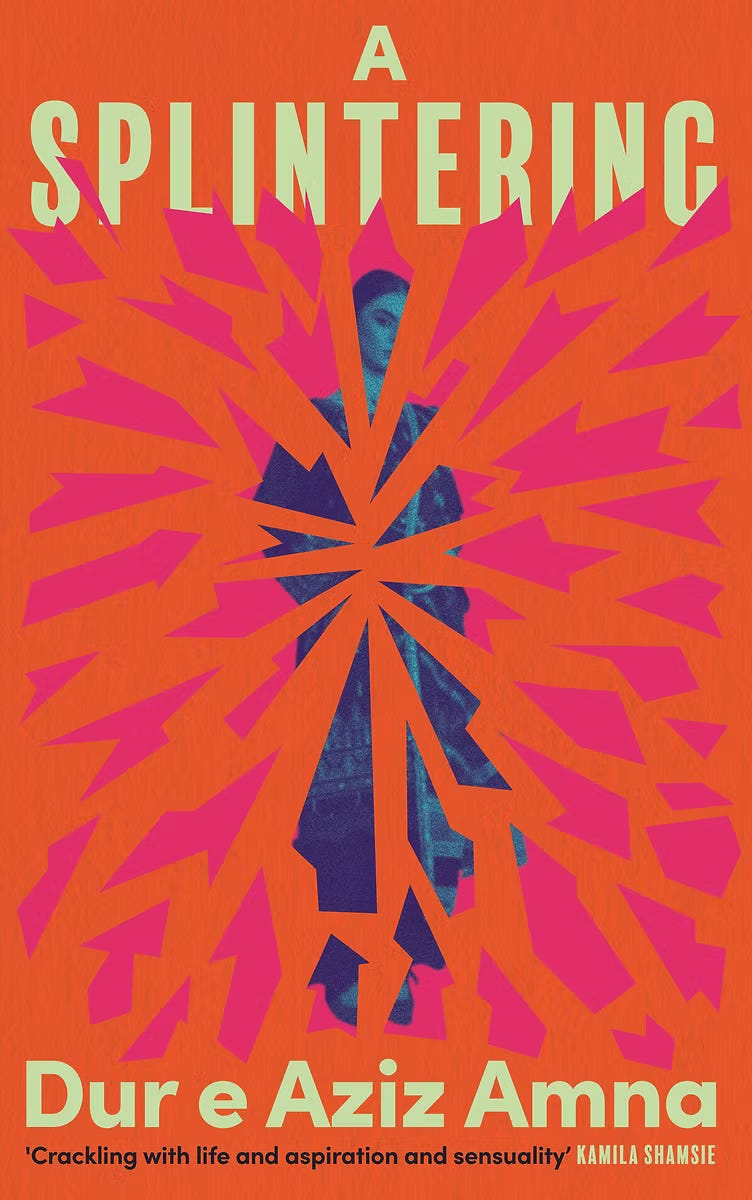
When we first meet the protagonist, Tara, we learn that she’s a woman from humble beginnings with a voracious appetite for money. Her unbounded ambition catapults her from her small town in rural Pakistan to the country’s capital, and she soon attains a life for herself that was previously unimaginable. Fulfilling career, two kids, accountant husband. But once the trappings of a middle class life become available to her, she decides that it isn’t enough. She needs more.
Her story begins with an appeal to us, the dear reader. We are immediately welcomed and bargained with and it soon becomes clear that we are not a passive participant watching a tale unfurl, but rather Tara’s confidant. A reliable person for someone who wants to recount their tragic mistake. Tara wants, no, needs us to be on her side. Why? Maybe everyone else abandoned her. Perhaps it satisfies some guilty desire to confess. We understand little about her, but we are allowed into her inner world to bear witness to her downfall. And this chasm between what we know and how we feel about her is perhaps what propels us forward and makes us want to keep reading.
A couple of weeks ago, the writer Lincoln Michel wrote a brilliant piece on the many different types of POVs. It’s a great primer for anyone that hasn’t been in an English class in awhile, as well as anyone who wants to hear a fresh perspective on an old idea.
Underneath the first-person POVs, he outlines what he calls the “The Appeal” perspective. A first person, direct address not to some unnamed reader, but to a specific person inside of the novel. A Splintering doesn’t fit neatly into this rule, as it speaks directly to us, the unnamed reader, but it employs a thrilling variant as Tara encourages us to listen without judgement, at least not until we understand her life and where she comes from.
Shortly after her desperate plea, she explains the circumstances that lead to her downfall. In the first few pages we come to learn, in a thinly veiled, foreboding kind of way, the entire plot of the story to come.
Traditional storytelling dictates that we handle plot the same way Pavlov handles dog treats. Gradually release the details to lead the subject through a desired path. Show, don’t tell. But in the first few pages of A Splintering we are frontloaded with information. Told almost everything that is about to happen. At this point, it would be reasonable for us to walk away knowing what we know, but we can’t can’t because that would mean turning our back on our new fr iend, Tara. Her mea culpa then becomes the driving force of the narrative, the sole reason for us to stay.
I’m drawn to stories, stories that that defy conventional standards because they illuminate how capacious the art of fiction can be. Show, don’t tell can be a useful technique for authors struggling to write a scene or place, but sometimes we can simply tell the audience everything we have in store for them. Because once we’ve built up an intimate relationship with the reader, turned them into a confidant, or even an accomplice, then we can rest easy knowing that they’ll stay by our side.


